

Birthright Human Identity
Every human is born with a natural identity that no government, institution, or society can create or take away.
ServCollab calls this Birthright Human Identity. It recognizes every person first and foremost as a member of the human species. While legal, political, cultural, and social identities are important, they should never deny a person's humanity or prevent them from participating in society.
Birthright Human Identity provides a new way of understanding how service systems can better serve humanity.
Why Birthright Human Identity Matters
Across the world, millions of people experience exclusion, discrimination, stigmatization and invisibility within service systems because of imposed identities. Some people are denied access to education, healthcare, work, housing, mobility, or participation because governments, institutions, or societies impose stigmatizing identities onto them. Others are treated as less deserving, less visible, or less human because of nationality, legal status, ethnicity, religion, gender, sexuality, or other imposed identity categories. These vulnerability experiences can affect people experiencing statelessness, homelessness, poverty, displacement, racial discrimination, gender oppression, or other forms of institutionalized exclusion.
Service systems do not recognize all humans equally. Some people are fully recognized participants whose rights, strengths, and contributions are assumed to matter. Others are stigmatized and only partially recognized and experience conditional access, suspicion, or restriction.
Some are not recognized at all. When people are not recognized or are stigmatized within service systems, their strengths become difficult—or impossible—to express, develop, or convert into education, work, mobility, participation, contribution, and future opportunities. Their capabilities may exist, but service systems prevent them from becoming recognized human potential.
At ServCollab, we call this phenomenon state-imposed vulnerability.

What is State-Imposed Vulnerability?
We define state-imposed vulnerability as the extreme strength-repressing form of vulnerability caused by state-imposed identities.
State-imposed vulnerability occurs when service systems such as governments or institutions impose identities that systematically deny recognition, rights, resources, or participation.. In these conditions, vulnerability is no longer temporary or situational. It becomes structural, long-lasting, and deeply difficult to escape.
Statelessness is one of the clearest and most severe examples of state-imposed vulnerability. Millions of people experiencing statelessness live without full legal recognition, often across generations. Their strengths, education, aspirations, and capabilities may exist, but service systems prevent them from becoming recognized qualifications, meaningful work, mobility, stable livelihoods, political participation, or future opportunities.

State-imposed vulnerability can shape every stage of life:
-
birth registration
-
education
-
employment
-
housing
-
healthcare
-
mobility
-
political participation
The problem is not a lack of human ability, intelligence, or potential. The problem is that imposed identities prevent human strengths from being recognized, protected, and converted into education, mobility, work, safety, belonging, participation, and future possibilities.
Birthright Human Identity
To address state-imposed vulnerability, ServCollab proposes the concept of birthright human identity.
We define birthright human identity as the natural strength that enables strengths, mutual responsibilities, and opportunities for humans in the service systems of planet Earth.
The problem is not a lack of human ability, intelligence, or potential. The problem is that imposed identities prevent human strengths from being recognized, trusted, protected, and converted into real life opportunities. It:
-
precedes citizenship, nationality, documentation, or classification
-
cannot be granted or revoked by governments
-
provides the foundation for participation, dignity, and agency
Birthright human identity should inform how service systems are designed, governed, and evaluated. Birthright Human Identity provides a new foundation for strengthening human rights by recognizing that every person's humanity precedes the legal identities through which rights are often allocated.
Current human rights frameworks protect many important freedoms and protections. However, millions of people remain excluded because imposed identities still determine who is recognized as fully human within institutional systems. Birthright human identity recognizes that being recognized as fully human is foundational to human rights, participation, protection, and belonging within service systems.
Liberating the Strength of Birthright Human Identity
ServCollab uses two guiding mechanisms for liberating Birthright Human Identity. Wisdom levers for relieving burdens and wisdom cranes for enabling opportunity. All 6 levers and cranes are TSR articles, 4 of which are ServCollab Perspective articles.
Wisdom Levers for Relieving Burdens
Some systems reproduce exclusion, stigma, invisibility, and vulnerability. These harmful structures must first be dislodged.
Wisdom levers are conceptual tools for dislodging systems, assumptions, and practices that repress human experience.
Service Inclusion
Dislodges exclusionary identity rules that determine who counts as a legitimate participant in service systems.
Service Ecosystem Health
Dislodges ecosystem conditions that drain human strengths through instability, exploitation, or survival pressure.
Wiser Service Systems
Dislodges stigmatizing narratives and communication patterns that reproduce vulnerability through labels, documents, and institutional language.
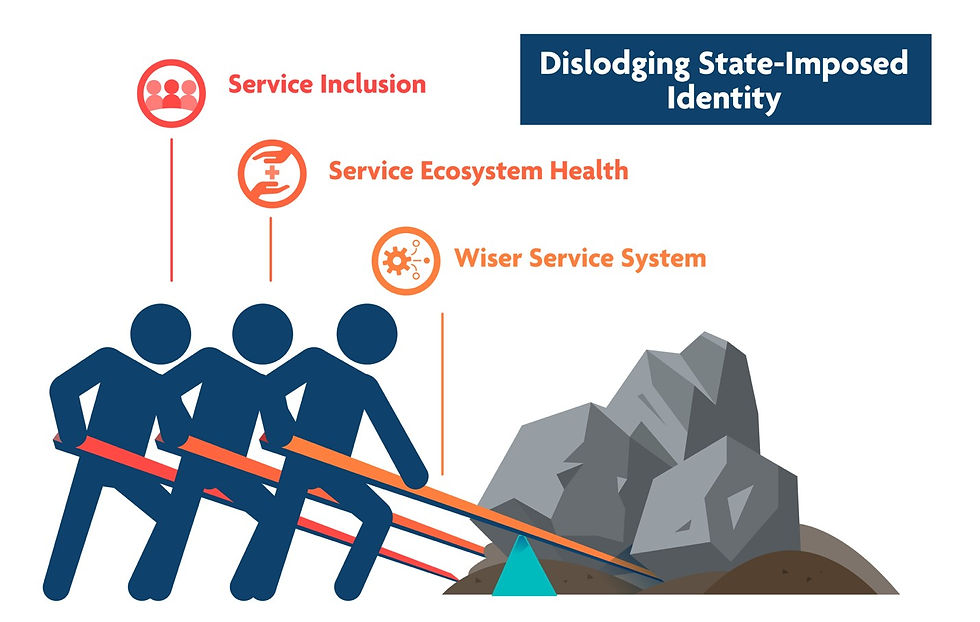
Dislodging harmful systems is necessary, but it is not sufficient. Removing exclusion does not automatically create dignity, participation, or opportunity.
That is why wisdom cranes are also needed.
Wisdom Cranes for Enabling Opportunities
Removing harm is not enough. Service systems must also actively create the conditions for dignity, participation, agency, and human flourishing.
Together, these principles guide how service systems can move from repressing human strengths to recognizing and enabling them.
Wisdom cranes are conceptual tools for constructing systems and relationships that elevate human experience and liberate the strength of birthright human identity.
Elevating Human Experience
Constructs service encounters in which human dignity and identity are recognized and respected.
Service Thinking Mindset
Constructs service systems that treat humans as mutualistic partners rather than administrative categories.
Service Standards for Humanity
Institutionalizes agency, dignity, and diversity within service systems.
Together, wisdom levers and wisdom cranes create the conditions under which birthright human identity can emerge as a recognized and protected human strength.

Upframing the Strength-Based Approach
Birthright human identity enables what we call an upframed strength-based approach.
Traditional strength-based approaches emphasize human capabilities, resilience, and resources. The upframed strength-based approach extends this logic by recognizing that strengths cannot flourish when service systems deny recognition itself.
By positioning birthright human identity as a foundational strength, the upframed strength-based approach helps service systems move beyond managing vulnerability toward enabling participation, dignity, agency, and human flourishing for all humans.
